BMI Explained: What Your Number Really Means

Body Mass Index is one of the most widely referenced health metrics in the world. It appears on medical charts, fitness apps, and insurance forms. But what does your BMI number actually tell you, and more importantly, what does it leave out? This guide breaks down the basics, the WHO categories, and the real-world limitations you need to know. If your BMI suggests you are carrying excess weight, our guide on how to lose belly fat covers the science-backed strategies that actually work.
What BMI Actually Measures
BMI is a simple ratio of your weight to your height squared. The formula takes your weight in kilograms and divides it by the square of your height in meters. The resulting number places you into one of several categories. It was designed as a quick population-level screening tool, not a diagnostic measure for individuals.
WHO BMI Categories
| Category | BMI Range |
|---|---|
| Underweight | Below 18.5 |
| Normal weight | 18.5 - 24.9 |
| Overweight | 25.0 - 29.9 |
| Obesity Class I | 30.0 - 34.9 |
| Obesity Class II | 35.0 - 39.9 |
| Obesity Class III | 40.0 and above |
The Limitations of BMI
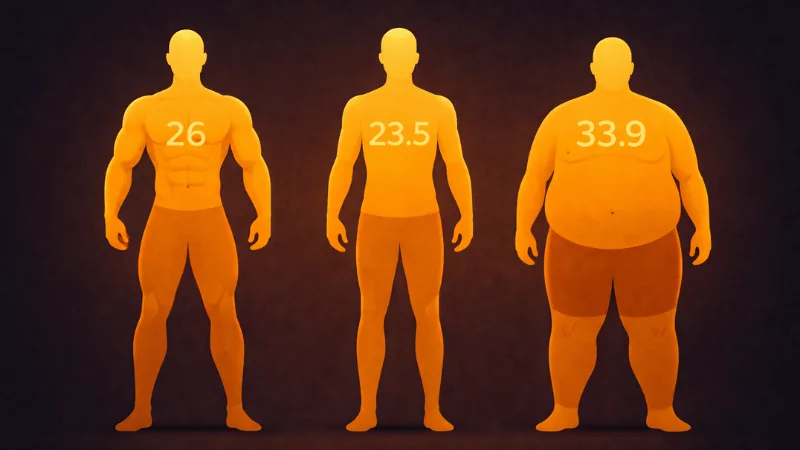
BMI cannot distinguish between muscle mass and fat mass. An athlete with significant lean muscle can easily register as overweight or obese on the BMI scale while carrying very low body fat. Similarly, an older adult who has lost muscle mass might fall in the normal range despite having an unhealthy amount of body fat.
- Muscle vs fat — BMI does not account for body composition at all. Two people at the same height and weight can have vastly different health profiles.
- Age and sex — BMI thresholds do not adjust for age-related changes in body composition or differences between men and women.
- Ethnic variation — Health risks can differ at the same BMI across different ethnic groups. Some populations face higher risks at lower thresholds.
- Fat distribution — Where you carry fat matters. Visceral fat around the abdomen is more dangerous than subcutaneous fat, and BMI tells you nothing about distribution.
When BMI Is Still Useful
Despite its limitations, BMI remains a useful starting point for the general population. It is quick to calculate, requires no special equipment, and at the population level, it correlates well with health risk. When combined with other measurements like waist circumference, body fat percentage, and blood work, BMI becomes part of a more complete health picture. Understanding whether you should eat in a calorie deficit vs surplus is often the logical next step after checking your BMI.
Better Alternatives to Consider
- Body fat percentage — Directly measures how much of your weight is fat vs lean mass. Our body recomposition guide explains how to improve this ratio.
- Waist-to-hip ratio — Captures fat distribution, which BMI ignores entirely.
- Waist circumference — A simple measurement strongly correlated with visceral fat and metabolic risk.
Check your BMI and get context on your number
Our tool explains what your result means, not just where you fall
Try the BMI CalculatorFrequently Asked Questions
BMI remains useful as a quick population-level screening tool, but it has significant limitations for individuals. It does not account for muscle mass, bone density, age, gender, or fat distribution. Waist circumference, body fat percentage, and metabolic markers provide a more complete health picture.
Body fat percentage (measured via DEXA scan, calipers, or smart scales) is more accurate for individual assessment. Waist-to-hip ratio identifies dangerous visceral fat. For a quick check, waist circumference alone is a strong predictor of metabolic health risk.
Kazi Habib
B.Pharm · MBA · PMP · Digital Marketing, York University
Kazi Habib is the founder of FitFixLife. With over 10 years in pharmaceutical and life sciences marketing, a Digital Marketing certification from York University (Toronto), and hands-on experience launching nutraceutical products at Beximco Pharmaceuticals — including science-backed meal replacers for weight management and diabetic nutrition — he brings regulated product development, clinical data analysis, and evidence-based content standards to every tool and article on this site.
Connect on LinkedIn →No spam. Unsubscribe anytime.
Related Articles
Calculate Your Maintenance Calories (3 Methods + Free Calculator)
Free TDEE calculator + 3 proven methods to find maintenance calories. Activity multipliers, tracking tips & 2-week adjustment protocol.
Macros Explained: Beginner's Guide to Protein, Carbs & Fat
What are macros and why do they matter? Simple breakdown of how to calculate protein, carbs & fat for your body and goals.
Try These Free Tools
Disclaimer: This article is for informational purposes only and does not constitute medical advice. Always consult a qualified healthcare professional before making changes to your diet, exercise, or supplement routine.