BMI Explained: What Your Number Really Means (2026)
BMI is a screening tool built for actuarial tables in 1832, not a clinical diagnostic for individuals. It tells you something useful at the population scale and almost nothing precise about any one body. It does not distinguish muscle from fat, cannot see where fat is stored, and uses cutoffs that under-classify cardiometabolic risk in South Asian, East Asian, Southeast Asian, and Middle Eastern populations per the WHO Expert Consultation 2004. If your BMI suggests you are carrying excess weight, our guide on how to lose belly fat covers the strategies that actually work.
TL;DR
- BMI is a population screen, not an individual diagnosis.
- Asian action points lower the cutoffs to 23 (increased risk) and 27.5 (high risk).
- Muscular adults are routinely misclassified as overweight by BMI.
- Normal-weight obesity is real: a normal BMI with high body fat carries higher metabolic risk than the number suggests.
- Pair BMI with waist circumference for a more honest read.
- Medications (steroids, antidepressants, GLP-1s, insulin) shift BMI independent of effort.
Why trust this guide
I am Kazi Habib, B.Pharm, MBA, PMP, 10+ years across pharmaceutical sciences and life-sciences marketing, founder of FitFixLife and PharmoniQ. I have personally tracked weight, BMI, waist circumference, and DEXA body composition across 4 years of structured body work. The recommendations below come from peer-reviewed clinical evidence plus the Canadian primary care context that US-focused fitness articles routinely miss.
What BMI actually measures
BMI is a simple ratio of weight in kilograms to height in meters squared. It was designed by Adolphe Quetelet in 1832 as a population-level statistical tool, not as a clinical metric for individuals. It got promoted to clinical use in the 20th century without losing its original limitations: it cannot distinguish muscle from fat, cannot see fat distribution, and uses a single set of cutoffs across populations with very different body composition patterns.
WHO BMI categories
| Category | BMI Range |
|---|---|
| Underweight | Below 18.5 |
| Normal weight | 18.5 - 24.9 |
| Overweight | 25.0 - 29.9 |
| Obesity Class I | 30.0 - 34.9 |
| Obesity Class II | 35.0 - 39.9 |
| Obesity Class III | 40.0 and above |
Where BMI fails: four real limitations
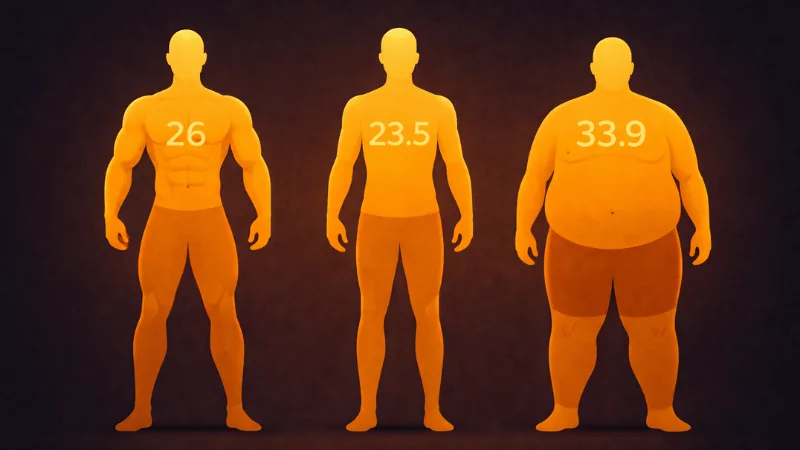
- Athletes and muscular adults. The Peterson 2014 NHANES analysis in Preventive Medicine documented routine misclassification of muscular individuals as overweight. BMI sees mass but not composition.
- Older adults. Sarcopenia (age-related muscle loss) hides behind "normal" BMI. A 75-year-old at BMI 23 with low muscle mass may have higher mortality risk than a 75-year-old at BMI 27 with intact muscle.
- South Asian, East Asian, Southeast Asian, and Middle Eastern populations. The WHO Asian action points (BMI 23 increased risk, 27.5 high risk) reflect higher body fat at lower BMI in these populations.
- Normal-weight obesity. The Romero-Corral 2010 paper in European Heart Journal documented higher cardiometabolic risk in normal-BMI adults with elevated body fat; waist circumference catches this, BMI does not.
Better metrics to use alongside BMI
- Waist circumference. Soft tape at the navel, relaxed. Health Canada cutoffs: 102 cm men, 88 cm women (40 in, 35 in); lower cutoffs for South Asian, Chinese, Japanese populations (90 cm men, 80 cm women per WHO 2008).
- Waist-to-height ratio. Target under 0.5 across most populations. Simpler than BMI and more predictive of metabolic risk in some analyses.
- Body composition (DEXA or smart-scale BIA). DEXA is the gold standard but $95-150 CAD per scan in Canada. BIA scales are fine for trend, mediocre for absolute number.
- Metabolic markers. Fasting glucose, HbA1c, lipid panel, blood pressure. A normal-BMI adult with poor metabolic markers carries real risk; an overweight-BMI adult with clean markers carries different risk.
The pharmacist take: medications that shift BMI
Corticosteroids (prednisone, dexamethasone): substantial weight gain via fluid retention and appetite. Antidepressants: mirtazapine, paroxetine, and amitriptyline carry the highest gain signal; bupropion (Wellbutrin) often produces small loss. Insulin and sulfonylureas: 2-6 kg gain in the first year of therapy. GLP-1 agonists (semaglutide, tirzepatide): substantial loss but roughly 30-40% lean mass, requiring high-protein intake and resistance training (see my Ozempic muscle loss and protein guide). Beta blockers: modest 1-2 kg gain plus blunted exercise capacity.
If your BMI changed substantially after starting a new medication, the medication is part of the explanation. Health Canada's Drug Product Database (DPD at canada.ca) lists side effect profiles for every drug sold in Canada.
The Canadian context in 2026
Diabetes Canada's 2018 clinical practice guidelines recommend type 2 diabetes risk screening at BMI 23+ for adults of South Asian, Chinese, African, or Indigenous ancestry. Ask your GP whether they applied the ethnic-specific cutoff. Obesity Canada's 2020 Adult Obesity Clinical Practice Guidelines explicitly moved away from a BMI-only definition of obesity, defining it as a chronic disease where excess body fat impairs health. Provincial health plans do not cover DEXA for body composition (only for osteoporosis); private DEXA runs $95-150 CAD per scan, generally not insured.
Practical decision tree
- Calculate your BMI at the FitFixLife BMI calculator.
- Check the ethnic-appropriate cutoff. Asian action points if applicable.
- Measure your waist circumference. Soft tape, navel, relaxed.
- Cross-check with one body composition measure (BIA for trend, DEXA for absolute).
- Interpret medications honestly. Recent prescription changes factor in.
- Act on the picture, not BMI alone.
Bottom line
BMI tells you something useful in 30 seconds. A soft tape measure tells you more in another 30 seconds. A DEXA scan tells you the truth in 7 minutes for $100 CAD. Use all three. Stop relying on BMI alone, and stop reading it in isolation from the demographic context that determines what the number actually means for your body.
Calculate your BMI at the FitFixLife BMI calculator. For broader metric tracking, see how to track your fitness progress.
Frequently Asked Questions
Not at the individual level. Athletes with above-average muscle mass routinely land in the BMI overweight category despite low body fat. The Peterson 2014 NHANES analysis in Preventive Medicine quantified the misclassification rate; substantial. For athletes, waist circumference and DEXA-based body composition are more useful than BMI.
The WHO Expert Consultation in Lancet 2004 recommended additional action points for Asian populations: increased risk at BMI 23 (vs 25 standard), high risk at BMI 27.5 (vs 30 standard). The cutoffs reflect higher body fat at lower BMI in South Asian, East Asian, and Southeast Asian populations.
Yes. The clinical term is normal-weight obesity. The Romero-Corral 2010 paper in European Heart Journal and the Mannisto 2014 study in British Journal of Nutrition both characterised the higher cardiometabolic risk in normal-BMI adults with elevated body fat. Waist circumference catches this; BMI alone does not.
They measure different things. BMI is a height-to-weight ratio. Smart scale BIA estimates body fat from electrical impedance. Use BMI for the height-weight summary, BIA for trend, and either waist tape or DEXA for the body composition truth.
Yes. Pediatric BMI uses age-and-sex-specific percentile curves (the WHO growth references adopted by Canada in 2010). A pediatric BMI is interpreted relative to percentile within the same age and sex, not against the adult cutoffs.
No. BMI is a screening tool, not a goal. Your target body weight should reflect the body composition and health outcomes you want, factored against your medical history, activity level, and personal context.
For non-Asian adults, 18.5-24.9 is the WHO normal range; for Asian adults, 18.5-22.9 is the comparable acceptable risk range. Within those ranges, where exactly you sit matters less than your waist circumference, body composition, and fitness markers.
Kazi Habib
B.Pharm · MBA · PMP · Digital Marketing, York University
Kazi Habib is the founder of FitFixLife. With over 10 years in pharmaceutical and life sciences marketing, a Digital Marketing certification from York University (Toronto), and hands-on experience launching nutraceutical products at Beximco Pharmaceuticals — including science-backed meal replacers for weight management and diabetic nutrition — he brings regulated product development, clinical data analysis, and evidence-based content standards to every tool and article on this site.
Connect on LinkedIn →No spam. Unsubscribe anytime.
Related Articles
How to Calculate Maintenance Calories (TDEE, Done Right)
Pharmacist guide to maintenance calories: Mifflin-St Jeor, Katch-McArdle, activity multipliers, NEAT, and the 14-day adjustment loop most calculators skip.
Understanding Macros for Beginners: Protein, Carbs, Fat (2026)
The beginner-friendly macro guide: what protein, carbs, and fat actually do, how to set targets by goal, and the simple Canadian halal sourcing plan.
Try These Free Tools
Disclaimer: This article is for informational purposes only and does not constitute medical advice. Always consult a qualified healthcare professional before making changes to your diet, exercise, or supplement routine.