How to Build a Workout Plan: 3-Day and 5-Day Templates
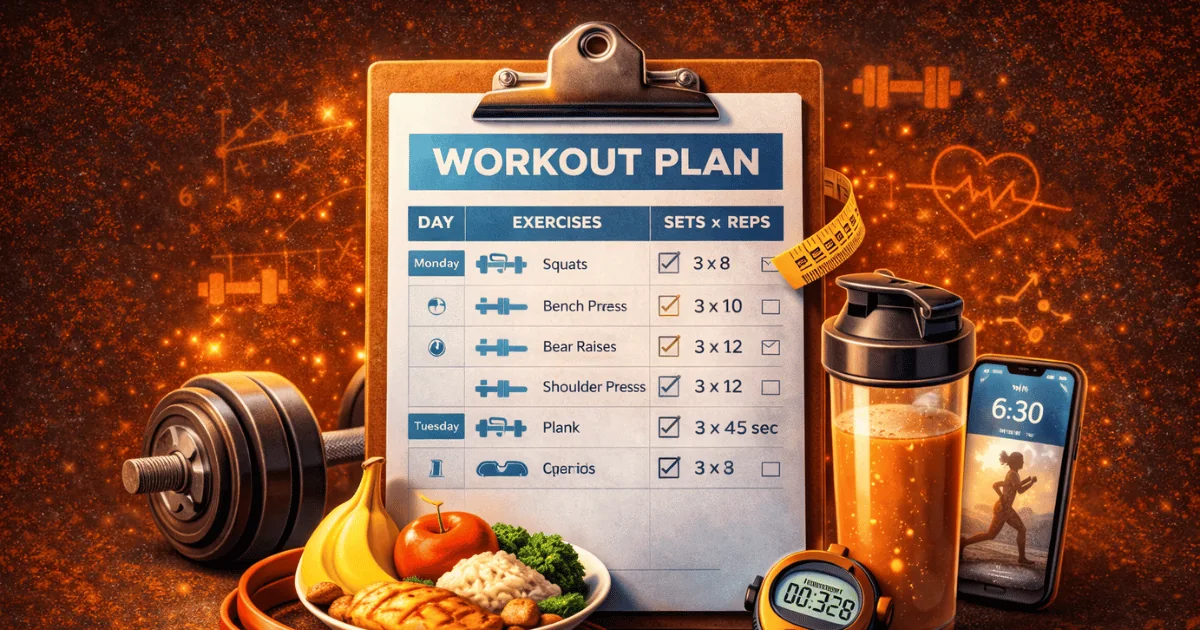
A workout plan that produces real results obeys three numerical constraints and four design rules. The constraints: 10 to 20 hard sets per muscle per week, training frequency of 3 to 5 sessions, and rest periods of 1 to 5 minutes scaled to the rep range. The design rules: compound lifts before isolation, push patterns balanced with pull patterns, lower body trained as much as upper, and progression tracked on at least one lever every session. The Schoenfeld 2017 meta in J Sports Sci (PMID 27433992) found a graded dose-response for muscle growth up to 10+ sets per muscle per week; the Schoenfeld and Grgic 2019 meta (PMID 30558493) showed frequency does not change hypertrophy when weekly volume is matched.
TL;DR
- A workout plan needs three numbers right: weekly volume per muscle (10-20 hard sets), frequency (3-5 sessions), and rest periods (1-5 min scaled to rep range).
- Volume is the strongest dose-response signal for muscle growth.
- Frequency does not change hypertrophy when weekly volume is matched. Pick the split that fits your life.
- Compound movements (squat, deadlift, bench, overhead press, row, pull-up) cover 70% of the productive volume; isolations add the remaining 30%.
- Beginners thrive on 3-day full-body programs; intermediates on 4-day upper/lower; advanced lifters on 5-6 day push/pull/legs.
- Progressive overload on at least one lever per session: load, volume, density, or technique quality.
- Deload every 4-8 weeks. Reduce weekly volume 40-60% for one week.
- Pharmacist note: creatine monohydrate 3-5 g/day raises productive volume tolerance 5-15%; chronic NSAID use blunts hypertrophy signaling.
Why trust this guide
I am Kazi Habib, B.Pharm, MBA, PMP, with 10+ years across pharmaceutical sciences and life-sciences marketing. The programming principles and templates below come from the meta-analytic resistance-training literature on PubMed, my own training logs across the November 2025 to April 2026 cycle, and pharmacist-perspective notes on NSAIDs, creatine timing, and statin interactions that the typical workout-plan article skips.
What a workout plan actually does
A workout plan is the structure that converts random gym time into measurable progress. Three things have to happen across the week for the plan to work: each working muscle receives adequate productive volume, adequate recovery time between training the same muscle, and progressive overload on at least one variable from session to session.

The three numerical anchors
Anchor 1: Weekly volume per muscle group
Target: 10 to 20 hard sets per muscle per week. The Schoenfeld 2017 dose-response meta found a graded benefit: each added weekly set produced roughly 0.37% additional muscle growth. A "hard set" means close to muscular failure (roughly 1 to 3 reps in reserve). Warm-up sets do not count.
Anchor 2: Training frequency
Target: 3 to 5 sessions per week, with each muscle trained 2 to 3 times per week. Frequency itself does not change hypertrophy outcomes when weekly volume is matched. What frequency does is determine per-session volume per muscle. For weekly targets above 12 sets per muscle, splitting across 2 to 3 sessions usually works better than cramming into one.
Anchor 3: Rest periods
- 3 to 5 minutes between sets for heavy compound work (1-6 reps).
- 1 to 3 minutes between sets for hypertrophy work (6-15 reps).
- 30 to 90 seconds between sets for isolation movements and metabolic finishers.
Skip the design work and use the workout generator
Splits, set/rep schemes, and rest periods auto-configured to your goal and training status.
Try the Workout GeneratorTemplate 1: 3-day full-body (beginner)
Best for: novice lifters, returning lifters after 6+ month layoff, time-constrained adults. 3 sessions per week (Monday, Wednesday, Friday). Each session 45-60 minutes. 3-5 hard sets per major muscle per session.
| Day | Workout |
|---|---|
| Monday (A) | Squat 3x5, Bench 3x5, Bent-over row 3x5, Plank 3x30s |
| Wednesday (B) | Deadlift 3x5, Overhead press 3x5, Pull-up or lat pulldown 3x8, Hanging knee raise 3x10 |
| Friday (A) | Repeat Monday with slightly heavier load |
Progress load every session for the first 2-4 months (add 2.5-5 lb upper, 5-10 lb lower). When load progression slows, increase to 4-5 sets per movement before adding session frequency.
Template 2: 5-day push/pull/legs/upper/lower (intermediate to advanced)
Best for: intermediate lifters (1+ year of consistent training), adults with 5-6 hours per week to dedicate. 5 sessions per week. Each session 60-90 minutes. 10-20 sets per muscle per week.
| Day | Focus | Key Lifts |
|---|---|---|
| Monday | Push (heavy) | Bench 4x5, Overhead press 4x6, Dips 3x8, Lateral raises 3x12, Triceps 3x10 |
| Tuesday | Pull (heavy) | Deadlift 3x5, Pull-up 4x6, Row 4x8, Face pull 3x12, Bicep curl 3x10 |
| Wednesday | Legs (heavy) | Squat 4x5, Romanian deadlift 3x8, Leg press 3x10, Calf raise 3x15 |
| Friday | Upper (volume) | Incline DB press 3x10, Cable row 3x12, Lateral raise 3x15, Bicep + tricep superset |
| Saturday | Lower (volume) | Front squat 3x8, Leg curl 3x12, Walking lunge 3x10, Standing calf 3x20 |
The four design rules
- Compound lifts before isolation. Squat, deadlift, bench, overhead press, row, pull-up cover 70% of productive volume. Do them when fresh.
- Push patterns balanced with pull patterns. Roughly equal weekly sets of push (bench, overhead, dips) and pull (row, pull-up, face pull). Imbalance produces forward-shoulder posture and rotator cuff issues.
- Lower body trained as much as upper. The most common programming error in recreational lifters. Lower body produces the most testosterone response and contributes more to overall body composition.
- Progression tracked on at least one lever every session. Load, reps, sets, technique quality, density. If nothing on paper is progressing, the plan is not working.
Deload weeks: when and how
Every 4-8 weeks, drop weekly volume 40-60% for one week. Keep weights similar but cut sets in half. Resume the following week slightly heavier than your prior peak. Signs you need a deload: training performance dropping despite consistent effort, sleep worsening, persistent joint soreness, resting heart rate climbing.
Supplement and nutrition integration
Protein. 1.6-2.2 g/kg body weight per day. The Jager 2017 ISSN position stand (PMID 28642676) supports this range. Without adequate protein, the training stimulus has nothing to build with.
Creatine. 3-5 g/day, daily, indefinitely. Raises productive volume tolerance per Kreider 2017 (PMID 28615996).
Caffeine. 3-6 mg/kg pre-training. Improves training performance and likely raises productive set quality.
Halal protein integration. Halal sources include chicken, beef, lamb, fish, eggs, dairy, lentils, chickpeas, plus halal-certified whey (Hayat Pharmaceuticals through halal grocery channels) or halal-friendly Naked Whey or Kirkland Signature for convenience.
Pharmacist drug-interaction notes. Chronic NSAID use blunts hypertrophy signaling. Statins (atorvastatin, simvastatin) can cause muscle soreness and creatine kinase elevation; talk to your prescriber if you experience persistent muscle pain on statins. Beta-blockers reduce maximum heart rate and may reduce training capacity. Discuss any prescription medication with your prescriber if it interacts with training capacity or recovery.
⚕️ Medical Disclaimer
This article is for informational purposes only and does not constitute medical advice. The content is not intended to diagnose, treat, cure, or prevent any disease. Always consult a qualified healthcare provider before starting or changing any supplements or nutrition strategies. Individual results may vary. See our full disclaimer for more information.
Frequently Asked Questions
3-5 sessions per week is the sweet spot for most adults. Beginners thrive on 3-day full-body programs. Intermediates do well on 4-day upper/lower splits. Advanced lifters often use 5-6 day push/pull/legs or body-part splits. Frequency itself does not change hypertrophy when weekly volume is matched.
10-20 hard sets per muscle per week for most trained adults. Novices can build with 5-10 sets because the relative training stress is higher. A hard set means close to muscular failure (roughly 1-3 reps in reserve), not warm-ups.
The one you will actually do consistently. Full-body 3x is best for beginners. Upper/lower 4x is the sweet spot for most intermediates. Push/pull/legs 5-6x suits advanced lifters who can accumulate higher weekly volume. None is universally superior.
45-90 minutes for most plans. Heavy compound work with long rest periods runs longer; circuit-style or supersetted hypertrophy work runs shorter. Sessions over 2 hours typically indicate too much volume per session or too much chatter between sets.
3-5 minutes for heavy compound work (sets of 1-6 reps). 1-3 minutes for hypertrophy work (6-15 reps). 30-90 seconds for isolation and metabolic finishers. Adequate rest preserves load on subsequent sets, which matters more than total time-under-tension.
Some cardio (3-5 hours per week of moderate activity, or 75-150 minutes of vigorous activity) supports general health without interfering with strength gains. Excessive cardio can compete with recovery and blunt hypertrophy. Time it after strength sessions or on separate days for best results.
Every 4-8 weeks. Drop weekly volume 40-60% for one week, keep weights similar, and resume training the following week slightly heavier than your prior peak. Signs you need a deload: training performance dropping despite consistent effort, sleep worsening, persistent joint soreness.
Yes. 1.6-2.2 g per kg body weight per day. Without adequate protein, the training stimulus has nothing to build with. Halal sources include chicken, beef, fish, eggs, dairy, lentils, chickpeas, plus halal-certified or halal-friendly whey for convenience.
Bottom line
Hit the three numerical anchors (10-20 hard sets per muscle per week, 3-5 sessions, rest scaled to rep range). Pick the split that fits your life. Compounds before isolation, push balanced with pull, lower body equal to upper, progression tracked on at least one lever per session. Deload every 4-8 weeks. 1.6-2.2 g/kg protein and 3-5 g creatine daily support the plan. The frequency wrapper does not matter when volume is matched; the volume does the work.
Kazi Habib
B.Pharm · MBA · PMP · Digital Marketing, York University
Kazi Habib is the founder of FitFixLife. With over 10 years in pharmaceutical and life sciences marketing, a Digital Marketing certification from York University (Toronto), and hands-on experience launching nutraceutical products at Beximco Pharmaceuticals — including science-backed meal replacers for weight management and diabetic nutrition — he brings regulated product development, clinical data analysis, and evidence-based content standards to every tool and article on this site.
Connect on LinkedIn →No spam. Unsubscribe anytime.
Related Articles
Progressive Overload Explained: How Muscle Actually Grows
Pharmacist guide to progressive overload: 4 levers (load, volume, density, technique), beginner-to-advanced protocols, deload weeks, creatine and NSAID notes.
Sleep and Recovery for Athletes: The Performance Multiplier (2026)
Sleep is the most underrated performance lever. How it drives muscle growth, fat loss, and recovery. Magnesium, melatonin, and Ramadan adjustments.
Try These Free Tools
Disclaimer: This article is for informational purposes only and does not constitute medical advice. Always consult a qualified healthcare professional before making changes to your diet, exercise, or supplement routine.